
anchors of quality
In tea industry, “fermentation” was firstly adapted to describe oolong teas, then it was replaced by “oxidation”. But what exactually happened during the oxidation processes which caused flavor changes was barely mentioned in global tea societies. Moreover, the adaption of the flavor wheels can describe the situation of a tea perfectly, but it doesn’t cover the origins (or say, reasons) of the flavors, especially when the similar flavors (for example, floral notes) are formed by 2 or more factors. besides, why oolong teas from certain regions always have layers of rich and strong tastes while the peers from other regions tend to have aromatic characters close to scents of nature, elegant but light? If they are all “partly oxidated” oolong teas, why flavors & tastes can differ so large?
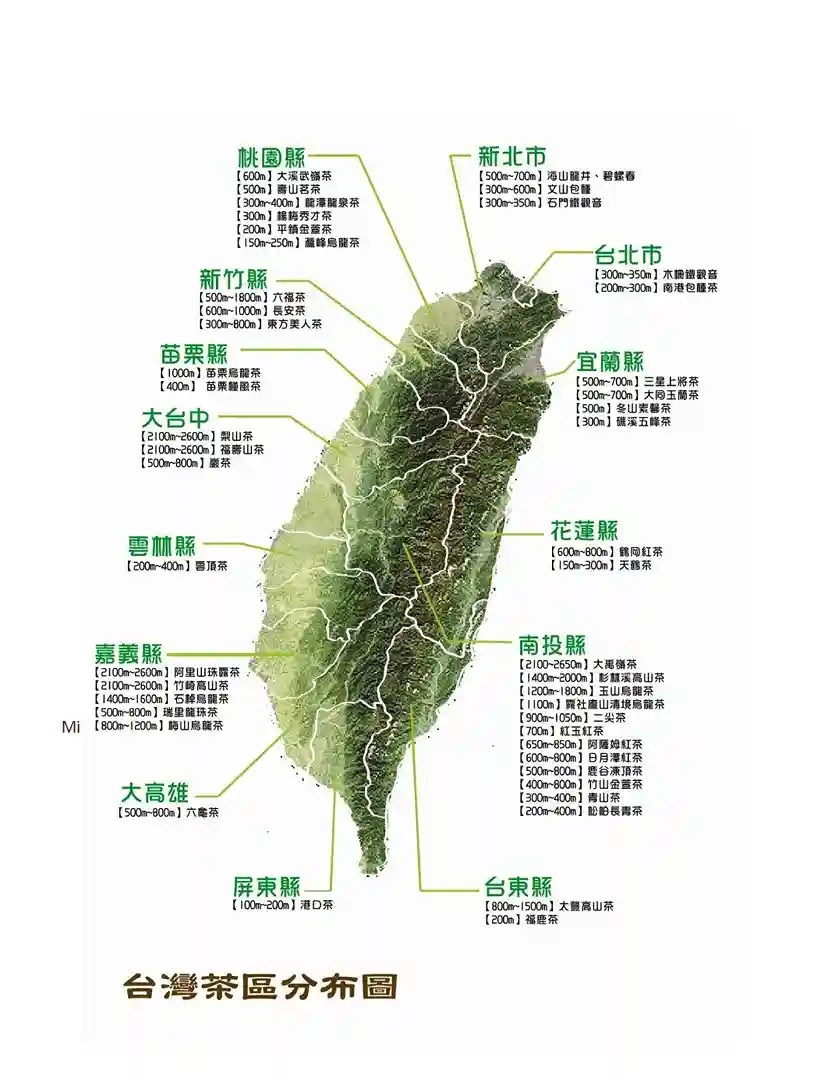
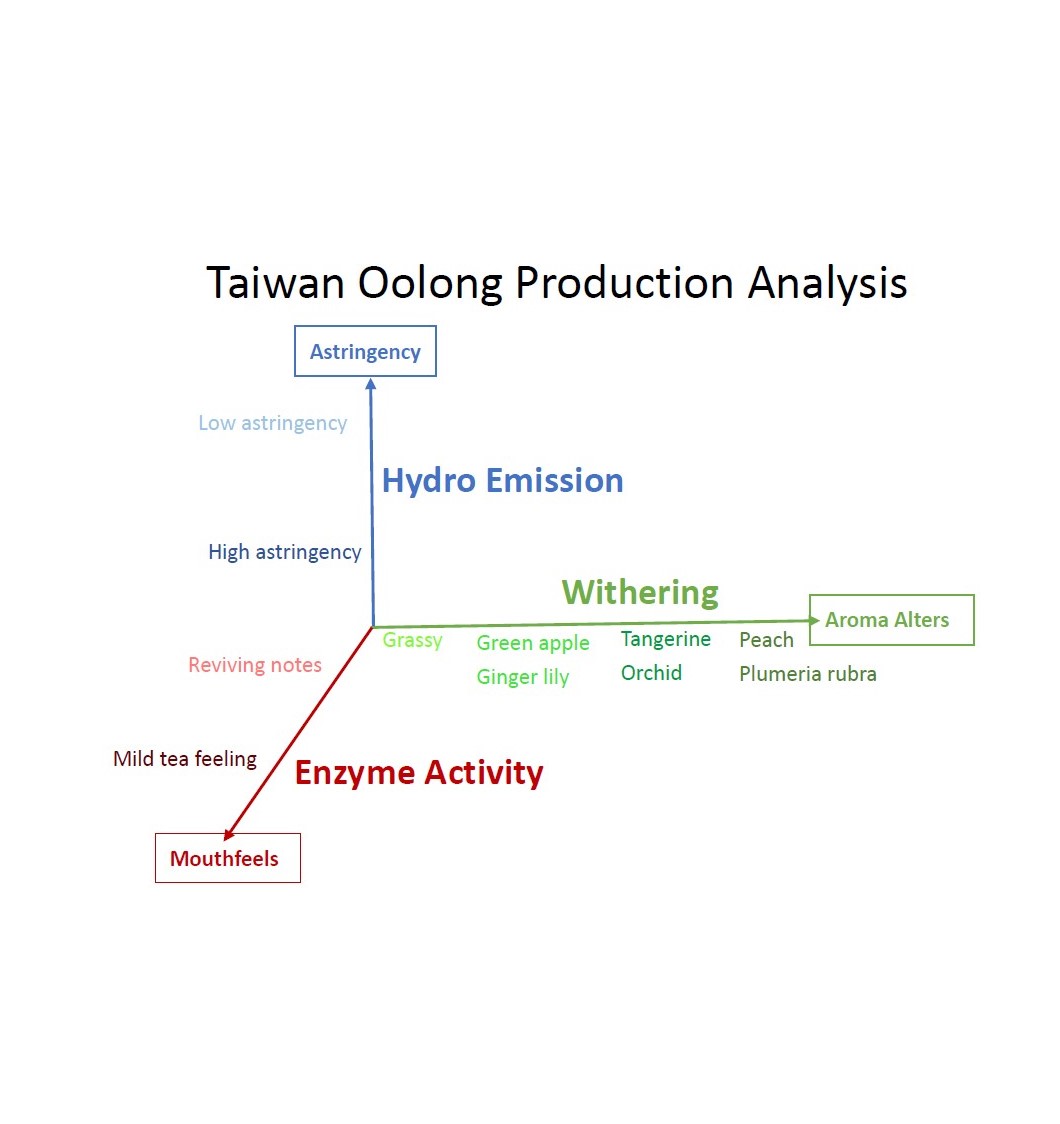
The oolong tea making concept of modern times has been formed and evolved since 1860s in China & Taiwan, and what we produce oolong is more complicated than just fermentation or oxidation, which can be proved by our languages describing handling processes; but on other hands, also due to this language barrier, those methods are not discovered and known by the world, yet those are the very methods which generate rich flavors. During tea making, we have been altering and adjusting moisture emission; however, how to describe them in English in a systematic way by using a framework turns out be the biggest challenge. When looking into the dictionary, either oxidation or fermentation has a clear definition, but what forms the flavors or a tea is more complicated than it in reality, but what to do to present those concepts all together in order to show the interactive yet individual mechanism? So the 3 dimensional curves in quadrant charts seem to be the best way.
The foundation is the flavor formation chart:
Any teas have specific tastes origin from the cultivars. It can be milky note (like JinXuan oolong), chill mints (like Ruby #18) or ginger lily (Sijichun) or any others; alongside the main note are other tones (floral or fruity). Secondly, there’re flavors from the transformation; when theanine, theaflavins, thearubigins, sugar, pectin and aroma substances are interacted and effected by temperatures, pressures and moisture, the flavors get changed. And the third one is the roasting that generates Maillard reactions, which acts strongly for those teas with high sugar and theanine contains. These 3 factors are represented by Axis X, Y & Z.
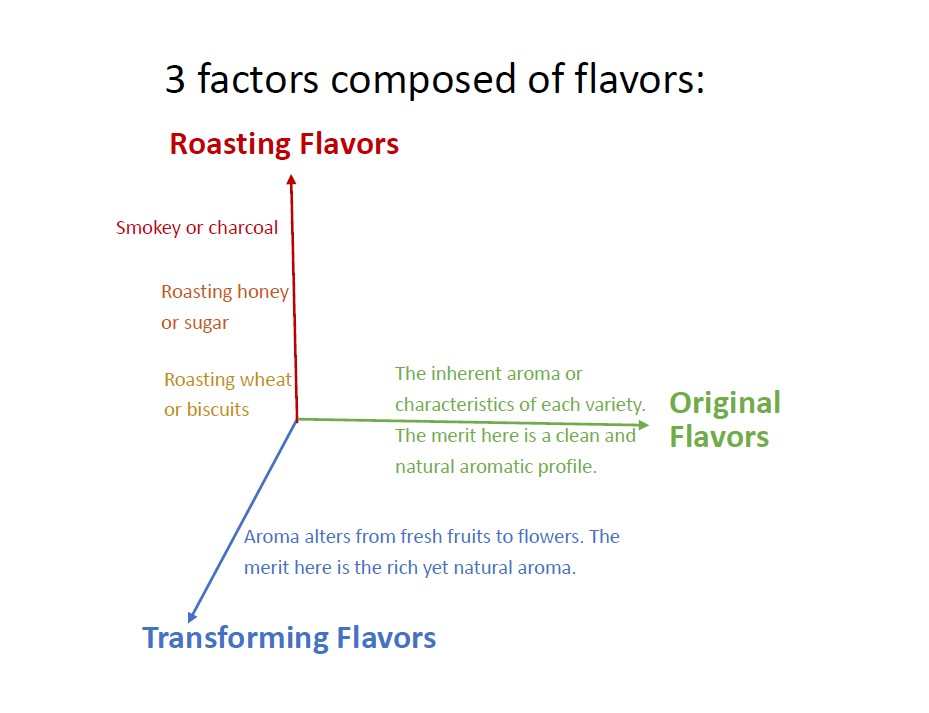
flavors of our tea are from 3 aspects; this is why TW oolong has so rich flavors.
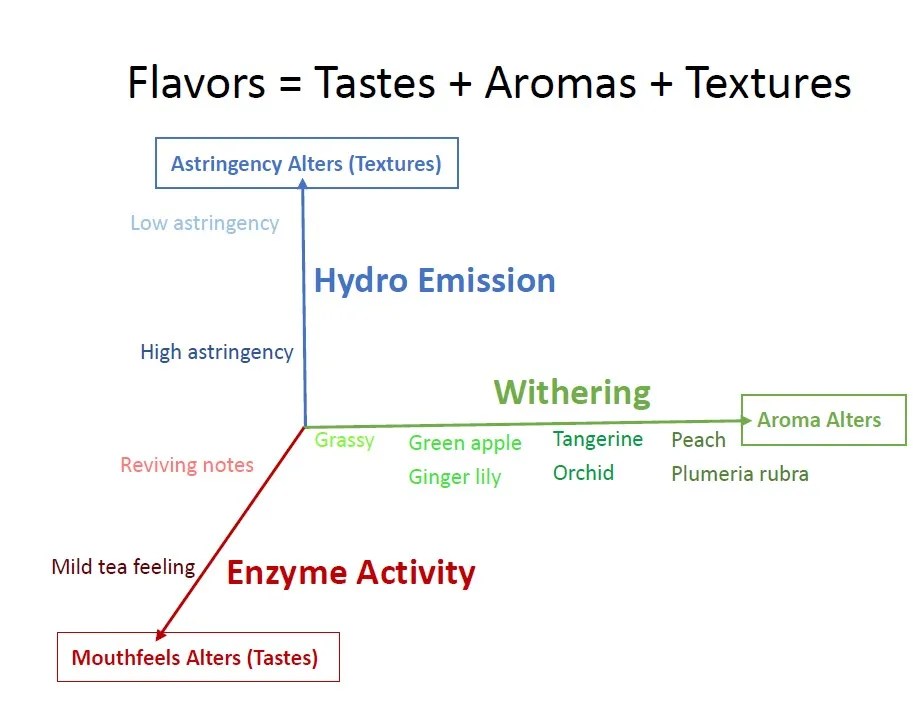
enjoying TW oolong from 3 dimensions. Tastes, armoa & textures.
As to the flavor transformation:
During the tea production, withering is the key to generate different aromas based on the original tastes of the cultivars; the stronger the withering, the richer and strong the aromas can be obtained. While the withering is conducted to certain level, the enzyme activities start, and it influences the mouthfeel of a tea, from a reviving note (or say, umami) to mild & smooth. Still, there are certain catechins and volatile compounds remained, especially much higher in tea buds and junior fresh leaves, that needs to be eliminated via emission in order to reduce the astringency as much as possible. All these 3 factors are marked by Axis X, Y & Z.
For English readers, they might think “withering, enzyme activities & hydro emission” are the same thing, and it’s much more the case especially for those who never produce teas. But just like stated above: these 3 methods are what we proceed “separately” during tea productions in TW for decades to generate different flavors, tastes and mouthfeel. Besides, before many traditional oriental knowledge spreading to the west, there aren’t any suitable and precise translations in that field; best examples can be Zen (Buddhist teachings as the system behind) or acupuncture (Chinese medical treatments as the system behind). Those concepts and conduction have been long existed in the east, yet remained unknown until the first touch from the west.
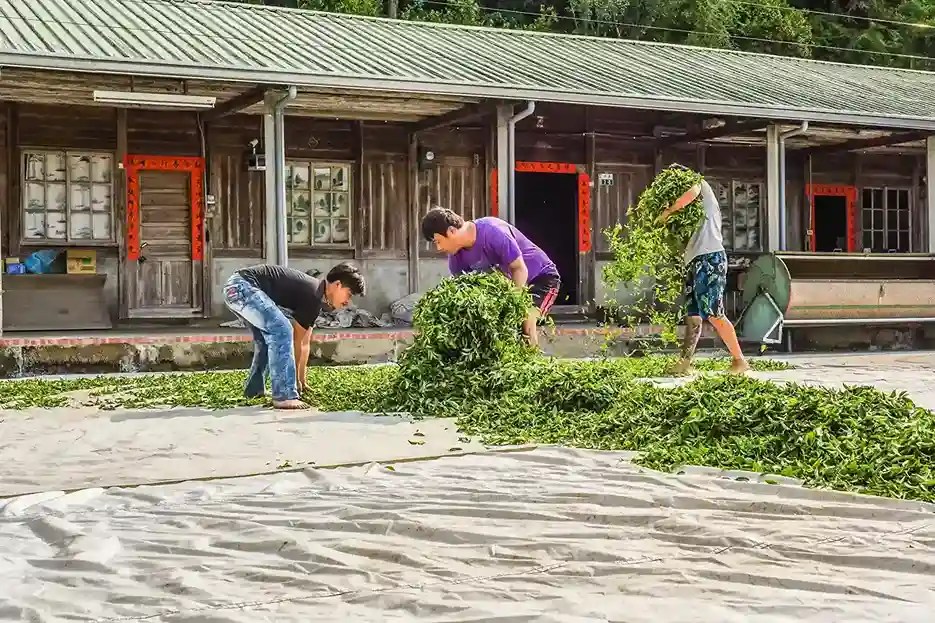
By stating the tea making system in Taiwan, we’d like to point out that, in our opinion, the core concept of the artisan tea should lie in sensational judgements of those rich and fine flavors generated and controlled manually by skillful tea makers in 33 non stopping working hours (not including roasting, which would take another several days or even longer) instead of measurable criteria such as small batches (kilograms) or hand-made or not. Afterall, every batch in Taiwan can reach few up to several hundred kilograms, and it can be plucked by machines or by hands, besides, the production is mostly done via great helps from machines. We believe that only non-quantitative factors of estate managements, tea producers & the weather decide the quality. And teas from us are produced by on guidelines of those methodologies above to have the highest performance in quadrant charts.
 Trilliant Industry